
Water Pump to Balancer Face Measurement: Why It Matters for Your March Performance System
One of the most important — and most overlooked — measurements in accessory drive setup is the water pump to balancer face dimension. If you're building a March Performance pulley system and your water pump or damper isn't stock, this measurement can be the difference between a system that aligns perfectly and one that throws belts.
What Is the Water Pump to Balancer Face Measurement?
This measurement is the distance from the front face of the harmonic balancer (damper) to the front face of the water pump snout — the surface where the water pump pulley mounts. This distance determines the relative offset between the crank pulley and the water pump pulley, which must be in precise alignment for the belt to run true.
March Performance engineers every pulley system around a specific water pump to balancer face dimension for each application. When that dimension matches, every pulley in the system lines up correctly straight out of the box.
Why This Measurement Changes
On a bone-stock engine with OEM water pump and damper, this measurement is consistent and predictable. But performance builds often deviate from stock:
- Aftermarket dampers — SFI-rated harmonic balancers often have different widths than the OEM damper, moving the crank pulley forward or backward
- Aftermarket water pumps — aluminum performance pumps frequently have different snout lengths than the original cast iron pump
- Engine rebuilds with different front covers — some aftermarket timing covers change the water pump mounting depth
- Stroker motors — some stroker kits require different dampers that affect the front face position
How to Take the Measurement
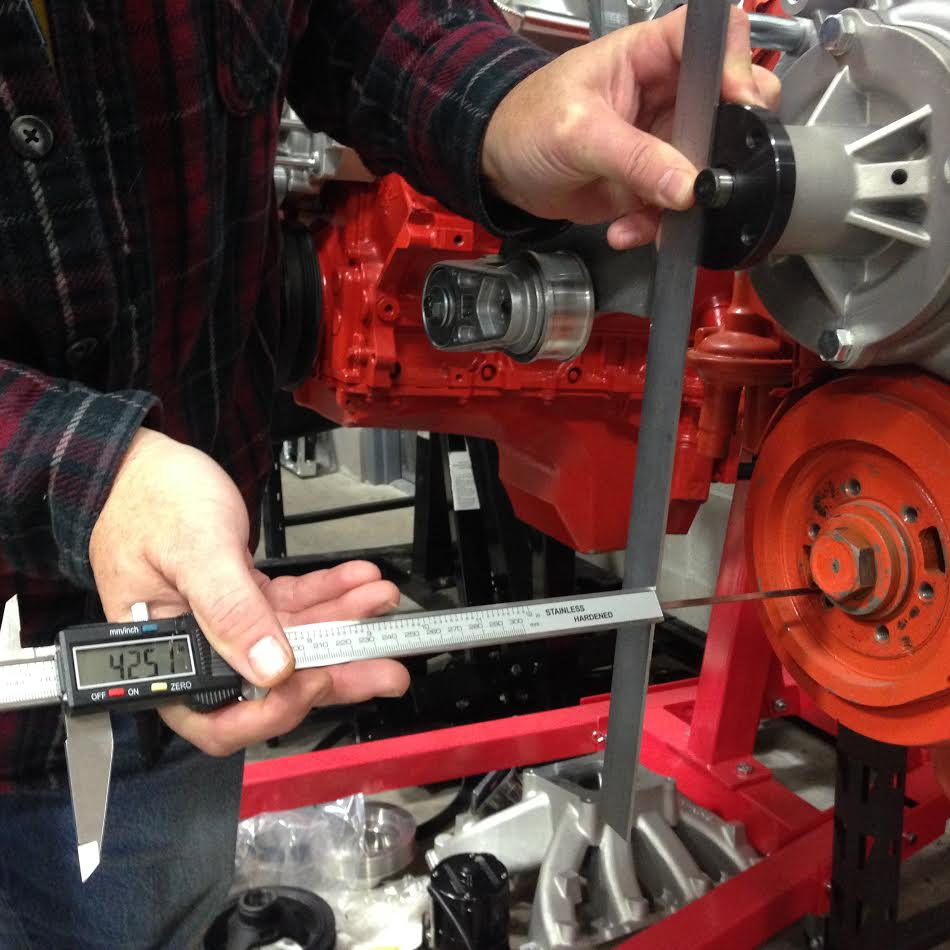
You'll need a quality caliper or a rigid ruler and a straight edge. Here's the process:
- With the damper and water pump installed but before installing any pulleys, place a straight edge across the front face of the damper
- Measure from that straight edge back to the front face of the water pump snout (the pulley mounting surface)
- Record this measurement in inches or millimeters
- Compare it to the specification listed in your March Performance kit instructions or call our tech line with the number
What to Do If Your Measurement Is Off
If your water pump to balancer face measurement doesn't match the spec for your March Performance system, don't panic. There are a few solutions:
- Pulley spacers — March Performance offers crank pulley spacers that move the crank pulley forward or backward to compensate for dimension differences
- Different damper selection — choosing a damper with the correct width for your system is often the cleanest solution
- Call our tech line — at 1.888.729.9070 we can walk you through your specific combination and recommend the right approach
Take the Measurement Before You Order
The best time to take this measurement is before you place your order — not after your March Performance system arrives. If you're running any non-stock water pump or damper, measure first and call us with the number. We'll confirm you have the right kit and flag any spacers or alternative components you might need.
Browse our full pulley lineup for Small Block Chevy, Big Block Chevy, Chevy LS, Small Block Ford, and Pontiac at marchperformance.com. Tech support: 1.888.729.9070.
Recent Posts
-
Will This March Performance Kit Fit My Application?
One of the most common questions we get at March Performance is simple: "Will this kit fit my engine …Apr 14th 2026 -
Torque Specs for March Performance Accessory Drive Systems: How Tight Is Tight Enough?
When you're building a show-quality engine bay with March Performance brackets and pulleys, getting …Mar 13th 2026 -
Small Block Ford Accessory Drive: The Complete March Performance Guide
The Small Block Ford — whether it's a 289, 302, or 351 Windsor — is one of the most popular engines …Jan 9th 2026